hexagonal Cyclosilicates
Maxixe-type Beryl
Be3Al2Si6O18
Crystal Structure
 #! Species: Maxixe-type Beryl (Be3Al2Si6O18; irradiated colour variety)
#! System: Hexagonal (6/mmm)
#! Habit: Prismatic hexagonal; deep navy-blue irradiation colour centre
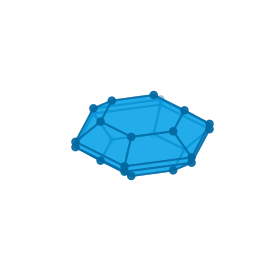
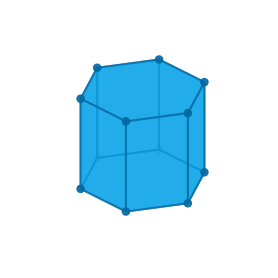
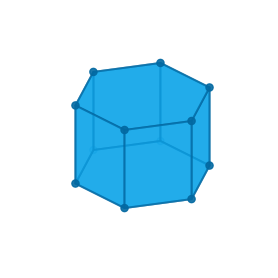
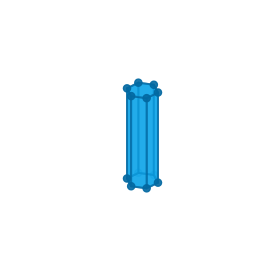
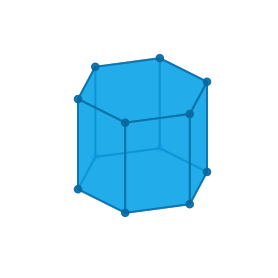
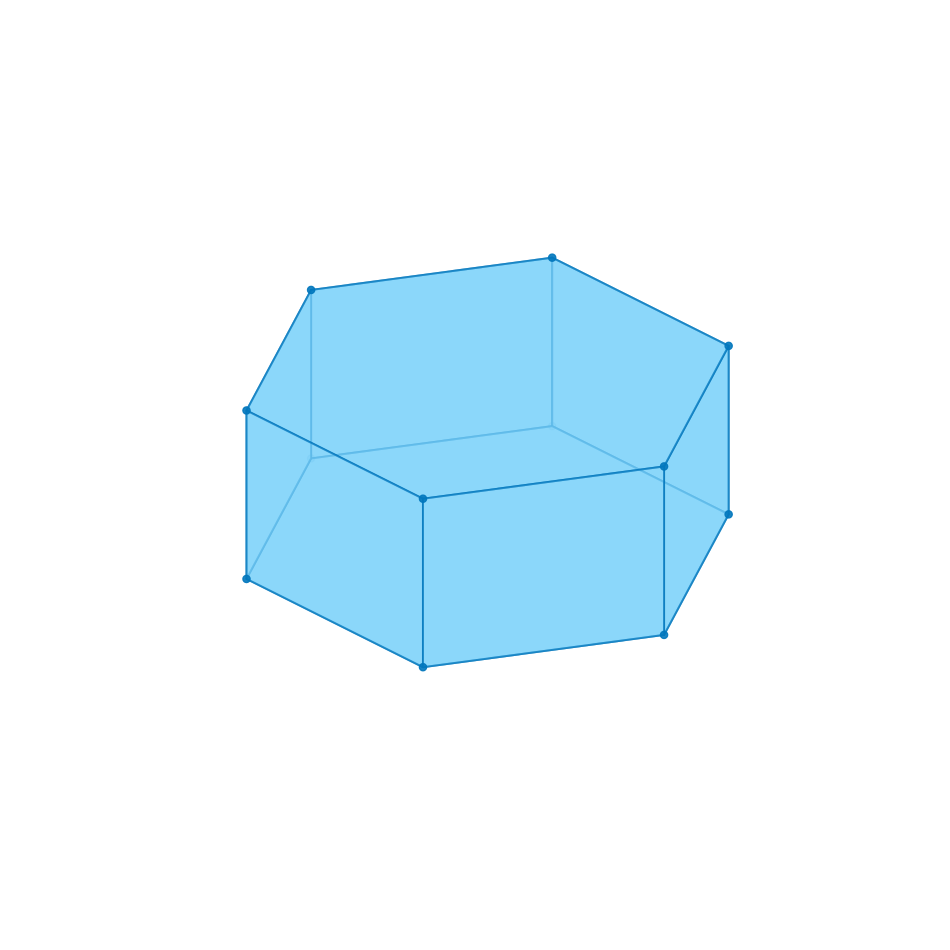
hexagonal[6/mmm]:{10-10}@1.0 + {0001}@0.6
hexagonal
6/mmm
{10-10} {0001}
Quick Facts
Hardness
7.5
Specific Gravity
2.68
Refractive Index
1.563
Optical Character
Uniaxial -
Interactive Preview
Open this crystal in the CDL Playground to rotate, export, and explore in 3D.
Open in PlaygroundPhysical Properties
Crystal Systemhexagonal
Hardness (Mohs)7.5
Specific Gravity2.68
CleavageImperfect basal
FractureConchoidal
LustreVitreous
Optical Properties
Refractive Index1.563
Birefringence0.005-0.008
Optical CharacterUniaxial -
Dispersion0.014
Pleochroismstrong: Deep blue (ordinary ray) / Colourless to pale blue (extraordinary ray)
Colours
Deep navy to inky blue (much more saturated than aquamarine)
Localities
Brazil (Maxixe mine, Minas Gerais; type locality for naturally irradiated blue beryl; mostly exhausted)Russia (Ural; possible occurrence per Andersson 2011)Any beryl from any locality can produce Maxixe-type colour by artificial irradiation treatment
Common Inclusions
[object Object][object Object]
Known Treatments
The colour itself IS a treatment in commercially sold Maxixe-type (artificial irradiation of colourless or pale beryl)[object Object]
Crystal Forms
prismpinacoid
Diagnostic Features
Deep navy to inky blue much more saturated than aquamarine; strong dichroism deep blue/colourless (stronger than aquamarine blue-green/colourless); CRITICAL: colour FADES on prolonged light exposure (sunlight/UV) — aquamarine does NOT fade; absorption spectrum differs from aquamarine (CO3-related bands ~575, 610, 650-700 nm vs Fe2+ in aquamarine)
Notes
Irradiation-induced deep blue colour variety of beryl (Be3Al2Si6O18). Chemistry per VERIFIED.md conflict resolution F-01: correct cyclosilicate formula Be3Al2Si6O18 (NOT Be3Al2(SiO3)6). Colour centre: CO3^2- or NO3^- ions in beryl channels are irradiated to create the colour centre. NOT caused by Fe2+ (as in aquamarine). Confirmed by Adamo, Pavese et al. 2008, Gems & Gemology 44(3):214-226 (DOI 10.5741/gems.44.3.214) [VERIFIED via live API]: primary modern reference differentiating Maxixe-type from aquamarine and synthetic blue beryl. Also Andersson 2011, Journal of Gemmology 32(5):145 (DOI 10.15506/jog.2011.32.5.145) [VERIFIED]. Colour centre mechanism: Fritsch & Rossman 1988 (DOI 10.5741/gems.24.1.3) [VERIFIED]. CRITICAL TRADE ISSUE: Maxixe-type colour FADES upon prolonged light exposure (UV/sunlight). Aquamarine does NOT fade. This is the single most critical trade distinction. UV lamp test (24-48 hours): Maxixe-type shows noticeable fading; aquamarine unchanged. Disclosure as irradiated fading colour is mandatory. Store in dark; warn customer.
Interactive Preview
Open this crystal in the CDL Playground to rotate, export, and explore in 3D.
Open in PlaygroundRelated Minerals
Other minerals in the hexagonal system